How to solve IQ test matrices: 4 rules with examples
An IQ test matrix is a 3×3 grid of figures with the last cell missing. At first glance it looks like a puzzle with no key. When I was writing the matrix generator for our test, it turned out the key is simple: a few rules, always the same ones. I’ll show you four, each on a real matrix from the generator, and the order I check them in.
There are only a few rules
I didn’t come up with this. In 1990, psychologists Patricia Carpenter, Marcel Just and Peter Shell broke down the problems in the advanced version of Raven’s Progressive Matrices, the best-known test of this kind. Almost every problem could be described by five rule types or a mix of them: constant in a row, progression, figure addition or subtraction, distribution of three values and distribution of two values.
The more interesting part is what they saw when they watched people solve them. Everyone worked in a similar way, piece by piece, one rule at a time. Stronger solvers were mostly better at catching more abstract rules and at keeping several things to check in their head at once. There’s a way to help with that second part.
The method: one feature at a time
Each cell of a matrix has several features. In our test there are three: the shape of the figures (circle, triangle, square, diamond or star), how many there are (one to five) and their fill (empty, lines, grid or solid). Each feature has its own rule, independent of the others. Most people get stuck because they look for one rule that explains the whole picture.
Here’s what I do:
- Pick one feature, say the number of figures, and ignore the rest for now.
- Read the first row from left to right and check the rules, simplest first. Does the feature stay the same? Does it grow or shrink by a fixed step? Are there three different variants in the row? Is the third cell the sum or difference of the first two?
- Check that the second row does the same. If the rows tell you nothing, do the same with the columns.
- Work out that feature’s value in the missing cell and remember it or write it down.
- Repeat for every feature and build the answer from the pieces.
- Only now look at the answer options. The right one matches on every feature. If none does, go back to the feature you were least sure about.
In Pattern, our matrix game, you build the answer exactly like that: you pick the shape, the number and the fill separately.
Rule 1: constant in a row
The simplest one. A feature stays the same within a row and changes only between rows. It can work down the columns too.
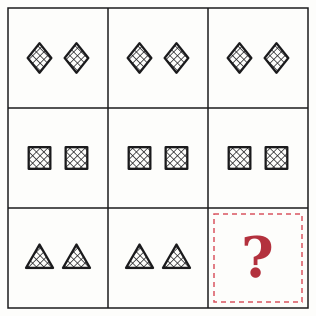
Only the shape changes: diamonds, squares, triangles. So the missing cell gets two grid-filled triangles. In hard problems this rule almost never shows up alone. Usually one feature stays put while the rest change by harder rules. Spot it fast so you don’t go looking for something hidden in it.
Rule 2: progression
A feature grows or shrinks by a fixed step. Each cell has one more figure than the last, or the fill gets one step denser. Fills have an order too: empty, lines, grid, solid. The first row shows the direction and the step, but each row can start from a different value.
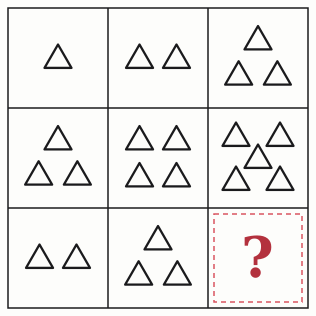
The first row is one, two, three triangles. The second is three, four, five. The third starts at two, then three, so four are missing. The columns look random here (1, 3, 2), so if you start by reading down, you’ll waste time.
Rule 3: distribution of three values
Three variants of a feature, say a square, a circle and a diamond, appear exactly once in every row, each time in a different order. Like sudoku: the missing cell gets whatever the row doesn’t have yet.
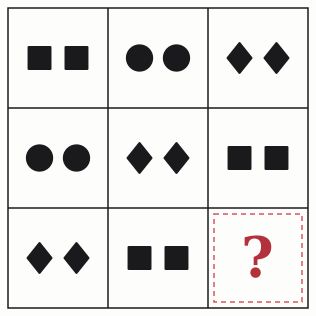
The third row already has diamonds and squares, so it’s missing circles, two solid ones. This is the easiest rule to miss. The rows look shuffled, nothing grows and nothing stays put. You’ll recognize it because every row holds the same set of three variants.
Rule 4: addition and subtraction
In Raven’s matrices that use this rule, the third cell is made from the first two: the figures are laid on top of each other, or one is taken away from the other. In our test it applies to the number of figures. The third cell holds as many as the first two together, or the difference between them.
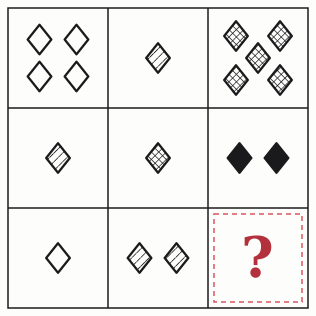
There are two rules at once here, which shows why splitting by feature helps. Number first: 4 + 1 = 5 and 1 + 1 = 2, so in the third row 1 + 2 = 3. Then the fill, which gets one step denser along each row (empty, lines, grid). After lines comes grid. The answer is three grid-filled diamonds.
I check this rule when the number of figures changes without a fixed step. Add or subtract the numbers in the first two cells and see whether you get the third.
What else to look for in Raven’s test
The fifth rule from Carpenter, Just and Shell’s study is the distribution of two values. An element appears in two cells of a row and is missing from the third. If something in a matrix appears and disappears with no visible order, count how many times it shows up in each row. Our test doesn’t use this rule, but Raven’s does.
Your turn
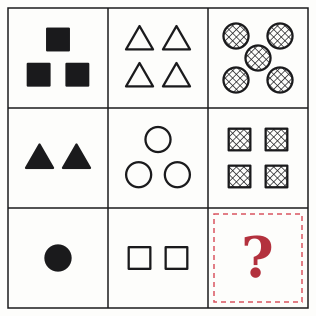
This matrix comes from a level that shows up in the second half of our IQ test. Each feature has a different rule here, and one of them works down the columns.
Show the solution
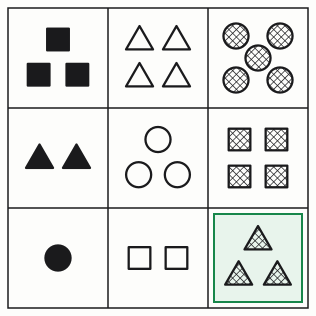
Shape: every row has a square, a triangle and a circle, and the third row is missing the triangle. The number grows by one along each row (3, 4, 5, then 2, 3, 4), so one and two are followed by three. The fill is constant down each column, and the third column is always grid. Answer: three grid-filled triangles.
Can practice improve your score?
Yes, but less than prep courses suggest. A meta-analysis of 122 studies of cognitive ability tests found that on a second attempt at the same kind of test, scores go up by a third of a standard deviation on average. That’s about 5 IQ points. By the third attempt the total gain is half a standard deviation, and then it stops. Tests with figures, like matrices, came out practically the same.
Where does the gain come from? Mostly familiarity. You know the format and the rules, so you don’t spend time figuring out what’s going on. In 2007, te Nijenhuis and colleagues looked at studies of these gains and found they don’t involve the g factor, the general ability intelligence tests are meant to measure. Your score goes up; your intelligence doesn’t.
If you have a matrix test coming up in a hiring process, do a dozen or so problems beforehand so you’re not learning the format during the test. And if you want to know how you really do, the first attempt is the one that counts. That’s why the norms of our IQ test only use first attempts. I wrote about what an IQ score actually means and how to spot a scam in Are online IQ tests accurate?
Sources
- Carpenter, P. A., Just, M. A., & Shell, P. (1990). What one intelligence test measures: A theoretical account of the processing in the Raven Progressive Matrices Test. Psychological Review, 97(3), 404-431. doi:10.1037/0033-295X.97.3.404
- Scharfen, J., Peters, J. M., & Holling, H. (2018). Retest effects in cognitive ability tests: A meta-analysis. Intelligence, 67, 44-66. doi:10.1016/j.intell.2018.01.003
- te Nijenhuis, J., van Vianen, A. E. M., & van der Flier, H. (2007). Score gains on g-loaded tests: No g. Intelligence, 35, 283-300. doi:10.1016/j.intell.2006.07.006